
New light field displays effectively simulate teleportation
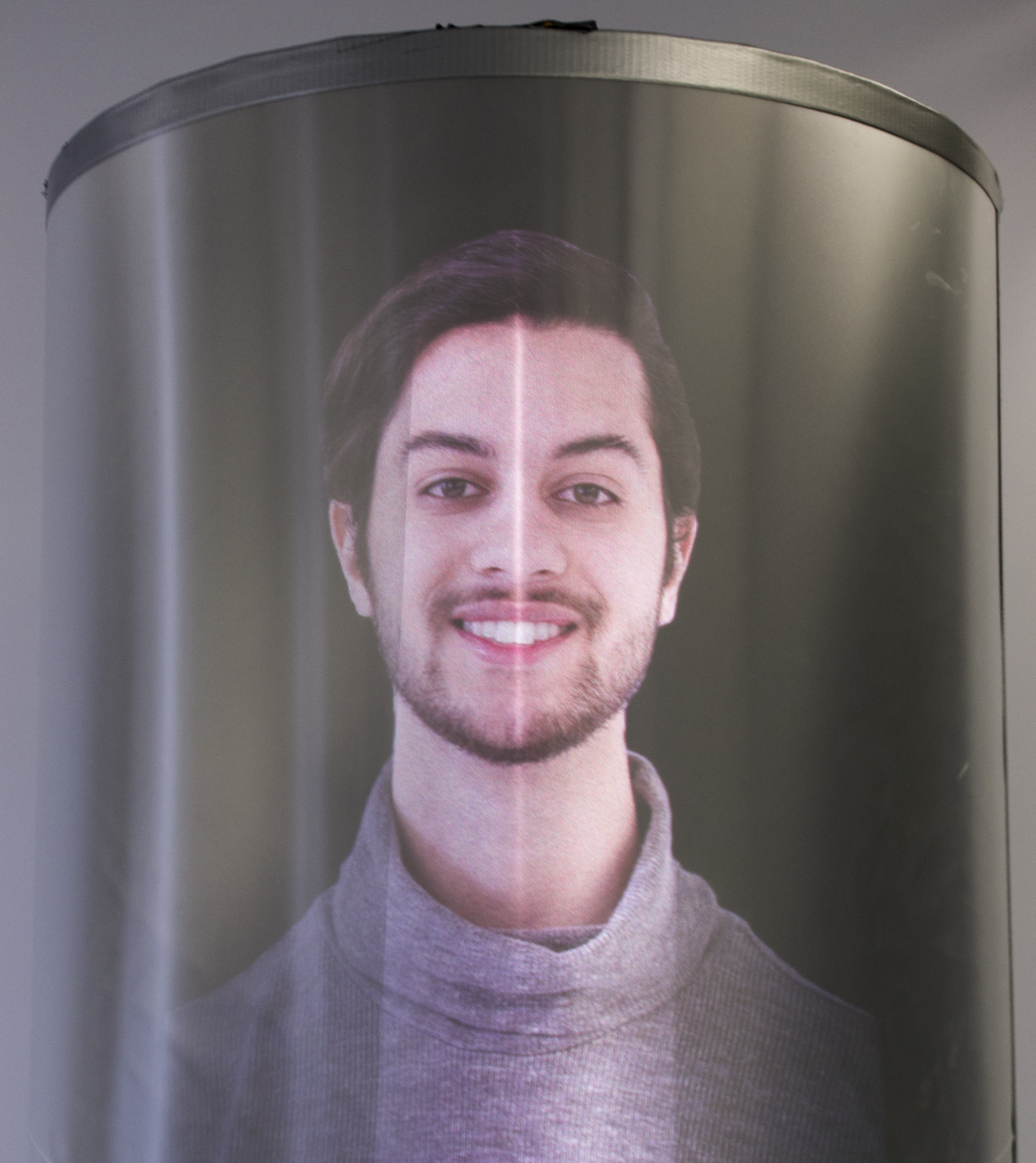
MONTREAL – This week, a Queen's University researcher will unveil TeleHuman 2 - the world’s first truly holographic videoconferencing system. TeleHuman 2 allows people in different locations to appear before one another life size and in 3D - as if they were in the same room.
“People often think of holograms as the posthumous Tupac Shakur performance at Coachella 2012,” says Roel Vertegaal, Professor of Human-Computer Interaction at the Queen’s University School of Computing. “Tupac's image, however, was not a hologram but a Pepper Ghost: A two-dimensional video projected on a flat piece of glass. With TeleHuman 2, we're bringing actual holograms to life.”
Using a ring of intelligent projectors mounted above and around a retro-reflective, human-size cylindrical pod, Dr. Vertegaal’s team has been able to project humans and objects as light fields. Objects appear in 3D as if inside the pod, and can be walked around and viewed from all sides simultaneously by multiple users - much like Star Trek's famed, fictional ‘Holodeck’. Capturing the remote 3D image with an array of depth cameras, TeleHuman 2 “teleports” live, 3D images of a human from one place to another - a feat that is set to revolutionize human telepresence. Because the display projects a light field with many images – one for every degree of angle – users need not wear a headset or 3D glasses to experience each other in augmented reality.
“Face-to-face interaction transfers an immense amount of non-verbal information,” says Dr. Vertegaal, head of the Queen’s Human Media Lab. “This information is lost in online tools, promoting poor online behaviours. Users miss the proxemics, gestures, facial expressions, and eye contact that bring nuance, emotional connotation and ultimately empathy to a conversation. TeleHuman 2 injects these missing elements into long-distance conversations with a realism that cannot be achieved with a Skype or Facetime video chat.”
Dr. Vertegaal first debuted the TeleHuman technology in 2012, but at that time the device only allowed for a single viewer to see the 3D projection correctly using 3D glasses. With TeleHuman 2, multiple participants are able to see their holographic friend or colleague in full 3D, each from their individual perspective, without glasses. To test the system, Dr. Vertegaal had users judge angles at which a robotic arrow, mounted on a tripod, was pointed, in two conditions: When physically present, and when rendered on TeleHuman 2. They did not judge the angles between the real and the virtual representation as significantly different.
“In a professional environment like a meeting, our latest edition of TeleHuman technology will do wonders for attendees looking to address colleagues with eye contact, to more effectively manage turn taking” says Dr. Vertegaal. “But it has potential beyond professional situations. Think again of a large music festival, and now imagine a performer capable of appearing simultaneously, as a hologram, on TeleHuman 2 devices throughout the venue – bringing a whole new level of audience intimacy to a stadium performance. TeleHuman technology could even mitigate environmental impacts of business travel – enabling organizations to conduct more engaging and effective meetings from a distance, rather than having to appear in person. “
Dr. Vertegaal and his collaborators will be presenting TeleHuman 2 to the general public at the ACM CHI Conference on Human Factors in Computing Systems, the premier international conference on Human-Computer Interaction, in Montreal, Canada on April 25, 2018.
References
Gotsch, D., Zhang, X., Merritt, T., and Vertegaal, R. TeleHuman 2.0: A Cylindrical Light Field Teleconferencing System for Life-size 3D Human Telepresence. In Proceedings of CHI’18 Conference on Human Factors in Computing Systems. ACM Press, 2018. [PDF]
Media Footage
High resolution photographs are available rights-free by clicking the thumbnails below. Please include a photo credit to Human Media Lab. A YouTube video is available here.
Media contacts
Dave Rideout
Communications Officer, Media Relations
613-533-6000, 79648
dave.rideout@queensu.ca
About the Human Media Lab at Queen’s University
The Human Media Lab (HML) at Queen’s University is one of Canada's premier Human-Computer Interaction (HCI) laboratories. Inventions include eye contact sensors, smart pause, attention-aware smartphones, PaperPhone, the world’s first flexible phone, PaperTab, the world’s first paper computer and TeleHuman2, the world’s first holographic teleconferencing system. HML is directed by Dr. Roel Vertegaal, Professor of HCI at Queen's University's School of Computing. Working with him are a number of graduate and undergraduate students in engineering, design and psychology.